Dr. Charschan's Blog

Dr. Charschan's Blog
Specializing in runners

Saturday, April 21, 2012

Fibromyalgia, joint pain and sleep. Finding a common ground through sleep.


Anyone who has been diagnosed with Fibromyalgia, or has joint pain and achiness has also likely been challenged by problems with the quality of their sleep.  Without getting too technical, sleep disturbance is one of the symptoms of Fibromyalgia.

Earlier this week, while dining with Dr. F (A well-known local Rheumatologist who helped craft the current criteria for Fibromyalgia) and Stu Carlitz, (the president of Eclipse who manufactures Therapedic as well as other brands of mattress), we had a lively discussion about chronic pain, Fibromyalgia and how to improve the quality of sleep in these individuals through better mattress design. 

During the conversation, it was clear that Dr. F who is currently involved in a drug trial and has pioneered the use of drugs such as Lyrica had a belief that Fibromyalgia according to the latest research is a neuro-chemical problem with a likely genetic basis (pain threshold is believed to be genetic based on current research).  Apparently, Lyrica is one of the drugs of choice for chronic Fibromyalgia and according to Dr. F, in Europe it is also approved as a sleep aid.  Dr. F believes based on what he has seen clinically that if you improve sleep, reported levels of pain are markedly reduced. 

The book Cheating Mother Nature, what you need to know to beat chronic pain talks about fibromyalgia in a more functional way.  One of the criteria is the 18 tender points which are not described other than to look for them as diagnostic criteria. In the medical world, if the person has a certain number of these tender points, and sleep problems, where they do not reach the deepest levels of sleep, they can be classified as having Fibromyalgia. In the book, it shows what the tender points are, which are areas of strain from Bio implosion, a concept pioneered by Brian Rothbart DPM, who is sort of a podiatric heretic who I believe based on years of observation and practice, figured out years ago the basis for chronic pain.  If bio implosion occurs only on one side, the asymmetry distorts the pelvis  in a similar way to how a towel is twisted which strains all the joints throughout the body.  This is as described in the book the reason chronic pain exists and the problem begins at the feet and is compensated by the myofascial that surrounds the core muscles.
The reality is that long term, as chronic pain develops, more pain results in a less restful sleep from the point of view of Cheating Mother Nature.  From Dr. F’s point of view, lack of sleep causes chronic pain, and Lyrica improves sleep quality and therefore helps these people function better. Dr. F also believes that Lyrica works on the neurology behind the abnormal pain these people experience.  Current research shows the body will adapt to its situations neurologically so chronic pain accommodation can go terribly wrong.
When trying to help those who meet the Fibromyalgia criteria, are we treating a disease classification with a drug that works while they take it, or do we fix the mechanical problems that create bio implosion to fix the problem.

A third idea comes to mind.  What if the mattress design addressed the sleep issue? This is why Mr. Carlitz decided we should work with one another and this is why the conversation was so fruitful.  We all agreed on the fact that better sleep improved pain levels.  The challenge now is to design a sleep system to address it head on, with the help of Dr. F’s guidance would decrease the reliance on drugs and allow people with mechanical basis problems to feel better and more refreshed in the morning.  The result will be less pain, less reliance on medication and while many of these people can benefit from the correct biomechanical interventions such as foot orthotics, fascial release treatment and manipulation, often their mattress offers a consistency not offered on today’s healthcare system since your mileage may vary between different healthcare providers and belief systems.

At the end of dinner, I gave Dr. F a copy of my book and suggested we get together for lunch or dinner more often.  We go back quite a few years as being friends and colleagues.  I think the open exchange of ideas is important, to avoid any of us from retreating back too far into our own ideologies.  While I believe that almost all chronic pain begins from asymmetry of the musculoskeletal system, I also believe there is a time and place for medical co management as well.  Conversely, they need to see things in a similar light.  At least we can agree on the importance of sleep and how a bed may be able to affect the growing problem of chronic pain.

Cheating Mother Nature is available through Amazon.com and other booksellers.  You can check out Dr. Charschan's authors page at whypeoplehurt.com and visit his blog at http://www.backfixer1.com/blog/.
Dr. F is a well known Rhumatologist in NJ who helped craft the current Fibromyalgia criteria. He is current involved in a 20 center drug trial to help those in chronic pain.

Thursday, March 15, 2012

Tiger Woods Achilles problem last week is a symptom of a bigger problem; Here's how to fix Tiger Woods before it is too late


Why did Tiger Woods have an achillies problem last week, or was there more to the story?

On, March 12th, CBS news reported that Tiger Woods had to withdraw from the Cadillac Championship because of what he described as a sore achillies tendon (http://www.cbsnews.com/8301-505245_162-57395267/tigers-woods-withdraws-with-sore-achilles-tendon/)
.  While many athletes have problems with their back and legs especially as they age, Tiger has had a history of left knee,  right ankle, and neck problems as well as a previously ruptured right achillies tendon (http://www.utsandiego.com/news/2011/jun/07/timeline-of-tiger-woods-injuries/) and stress tibial fractures in his left leg.

Of course, a professional athlete with his resources and reputation should have the best care anyone could ask for, and because of the high stakes of the game, he will not bow out of a tournament easily.

What if there is an obvious reason for the injuries that was never diagnosed because most health care practitioners have never learned about its importance.  The book, Cheating Mother Nature, what you need to know to beat chronic pain offers some vital clues to the reasons Tiger has had repeated problems in his legs and back.

Conventional wisdom in healthcare and sports would dictate that he is an elite athlete who has injured his Achilles tendon on the right and ripped up his left knee.  From a golfers perspective, the golf swing requires great pelvis stability during the swing which places stresses on these areas.  Most people from the conventional perspective fail to see what is obvious in these photos.

Those who are built asymmetrically are that way because of genetics.  As described by Brian Rothbart DPM in his bio implosion model, when the foot turns out, the leg rolls in and so does the shoulder as the lower back hyper extends in compensation.  As described in Charschan's basic pronation accommodation pattern, the muscles and the fascia will adapt to this holding it in place.  If you look at the photo's, notice that his right foot turns out.  This is foot overpronation which also drops his right hip lower.  The compensation for this on the other side is his lateral leg, hip flexors in the front will tighten, placing huge forces in the kneecap and the ligaments by creating shear.  On the right side where the foot turns out and the hip drops, the leg will have a shortened stride, which will create adhesion formation in the back of the knee and the gluteal muscles on that side, which will place tension into the calf and Achilles.

When we look at the complaints he has, this matches perfectly with his left sided knee injuries and right sided achillies problems.  Because his mid section will also distort, the unequal distribution of forces from the pelvis will cause his legs to tighten.  While the author of this article has never met Tiger Woods, it would be safe to say that he has a heavy heel strike and likely slams his foot in the ground which over time would lock up both that ankle and the hip on the same side making this problem worse.  It is also quite likely that he has to constantly work an unstable core which he has been able to stabilize despite his body style issues.

While scanning the internet, I have noticed some enterprising podiatrists seem to believe he may need a boot and foot orthotics.  The author definitely agrees with foot orthotics to level his pelvis  and help with stability while walking and then swinging the club,  boot idea works on the symptom only, rather than why he continues to re injure himself.

To make this simple, Tiger has a gait issue and everyone is looking at the injuries which are the micro vs. the gait issue which is the macro. The symptom he experienced was sciatica, not an Achilles issue although I have no doubt his Achilles was quite tight as well as his calf on the right side.

How to fix Tiger Woods.

1. Foot orthotics - improves his body style while allowing the transference of force through his core muscle during the swing for a better transference of force.
2. Fascial Release - Whether ART, Graston or another style, fascial release to improve his core and release the fascial distortion will take the load off his legs and allow for more power off the ball.
3. Core training after his stability improves.  He can use a personal trainer quite effectively after step 2. The Wii fit actually works quite well.
4. Chiropractic manipulation would be quite helpful.  I would be surprised if this is not part of his regimen.
5. Proprioceptive exercises to improve side to side balance, strength and coordination.

Tiger, I hope you read this.  It has been a tough few years for you and I would like to see you stage a great comeback.  Hopefully, someone will pass these tips along to you.

Wednesday, March 09, 2011

I'm taking bigger steps, my wife says

 The post has moved to

http://www.backfixer1.com/blog/im-taking-bigger-steps-my-wife-says/

Tuesday, March 08, 2011

The genetics of back pain - is back pain genetic or does a genetic trait cause back problems in families?

 Article has moved to
http://www.backfixer1.com/blog/the-genetics-of-back-pain-is-back-pain-genetic-or-does-a-genetic-trait-cause-back-problems-in-families/

Monday, March 07, 2011

Lower Back Pain Study Shows Chiropractic is Most Effective Treatment Long Term

 Post Moved to
http://www.backfixer1.com/blog/lower-back-pain-study-shows-chiropractic-is-most-effective-treatment-long-term/

Saturday, March 05, 2011

The US healthcare monopolies, and how cost shifting costs us


 Post moved to
http://www.backfixer1.com/blog/the-us-healthcare-monopolies-and-how-cost-shifting-costs-us/

Thursday, March 03, 2011

Better options for tendon problems - Hint; the tendon is a symptom, not the problem

Article has moved to 
http://www.backfixer1.com/blog/better-options-for-tendon-problems-hint-the-tendon-is-a-symptom-not-the-problem/

Tuesday, March 01, 2011

New article in NY Times talks about new theories about side stiches

Article has moved to

http://www.backfixer1.com/blog/new-article-in-ny-times-talks-about-new-theories-about-side-stiches/

The Equation Of Running And Winning Free Of Pain

 Post has moved to
http://www.backfixer1.com/blog/the-equation-of-running-and-winning-free-of-pain/

Friday, February 25, 2011

Should children run marathons - something every runner should consider reading

 Post has moved to
 http://www.backfixer1.com/blog/should-children-run-marathons-something-every-runner-should-consider-reading/

Sunday, February 20, 2011

USA Track and Field NJ y Open & Masters Indoor Track & Field Championships


Today, 2-20-11 I was on the medical staff for the USATF open and masters indoor track and field championships at the John Bennett Indoor Athletic Complex in Toms River.  As many of my patients already know, I have been their medical director since 1992 and also do my best to make sure that their events have medical staffing which is typically all volunteer.  


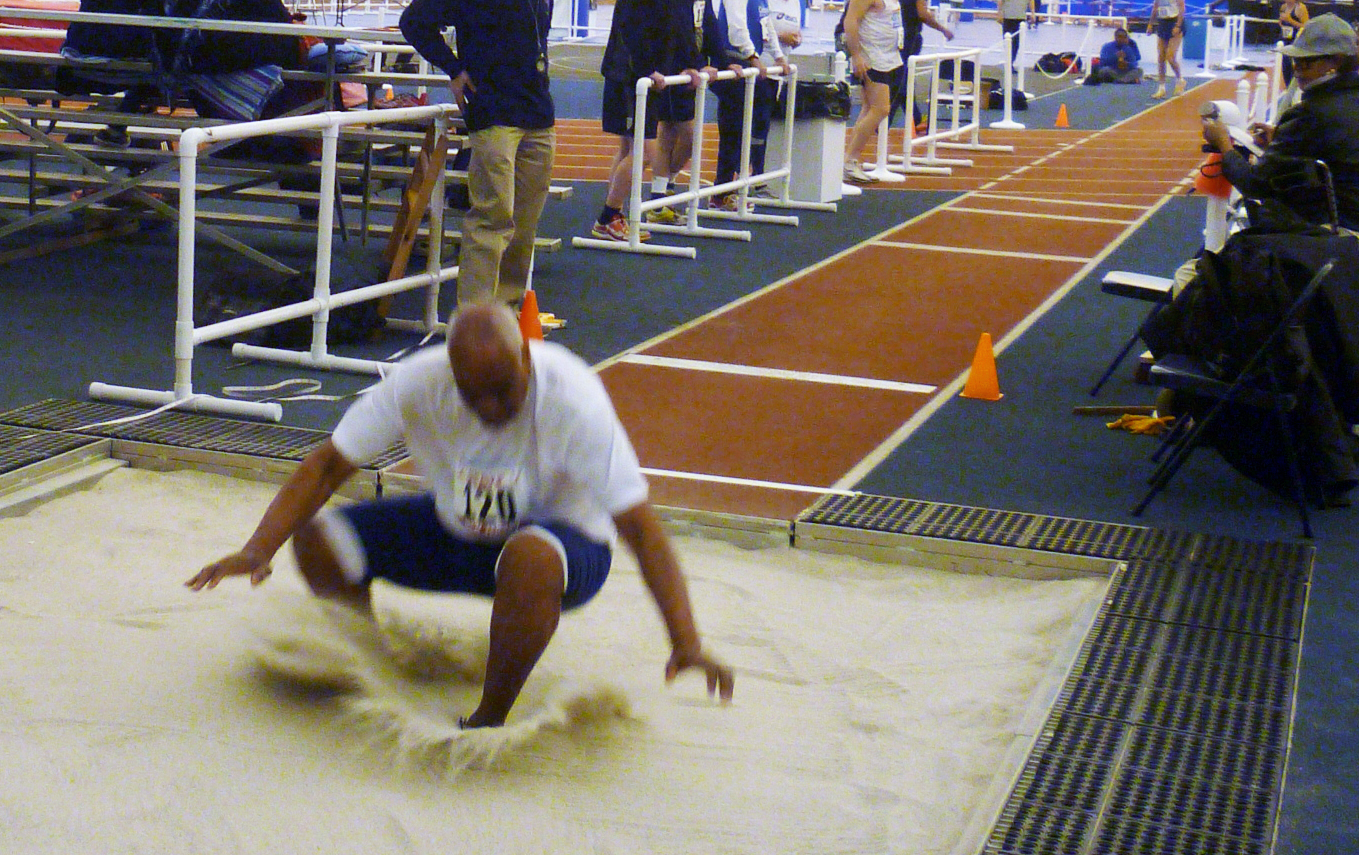
This particular event features athletes who are at lease 18 years of age and some are in the 80's.  Pictured above was the start of the 50 yard dash.  Below to the left is one of our patients, Jane Vaneewan who got into track and field when her doctor told her she had some health issues.  Rather than take pills, she found track and field and on a given weekend, is a national competitor, often doing at least one if not more events,  To the right was an older high jumper. I was watching his jumps which were quite good for his age group.  Lastly, the bottom photo was of a high jumper.  


I was quite busy today, since we had one runner who I suspect fractured his ankle and another who severely pulled his hamstring.  Stuff happens but I was also able to help quite a few runners.  When I was packing up and leaving, one of the runners I worked on came over to thank me.  I turned out that he had some problems that continually were occurring and he had been through all sorts of therapies which did not work.  He ran after I taped his feet and worked on him free of pain for the first time in years. He is planning to visit and bring members of his team he trains with to the office from Pennsylvania because he believes he finally found someone who understands running problems. 


 It is nice to receive that type of endorsement.  I also met a number of coaches who brought over their team members because the liked the way I helped their athletes.I love working with runners and seeing them improve with my treatment.  It is quite rewarding which is why I will work for pizza and soda and the occasional T Shirt I receive at an event.


Thursday, February 17, 2011

How to stay running injury free this spring

The weather is finally warming from this deplorable winter and many runners are testing out the roads during some of our warmer February days.  As many of our patients who run know, injuries tend to happen when you load up poorly functioning bodies with exercise.

Simple tests to screen yourself and see if your body may require some help before hitting the road.
1. Balance on one leg - This simple test where you balance on each leg, for 30 seconds will tell you if you are likely to have running problems.  Lift the leg until your thigh is perpendicular to your body (90 degrees).  If you lose your balance on one or both sides, you should visit your chiropractor or muscle therapist to have them find the muscular imbalance and correct it.  Often, problems in the back of the calf by the posterior knee are part of the problem as well as the gluteal muscles and the oblique muscles in the abdomen.  An imbalance of tension in these muscles will cause you to over and under stride with the net result being pain.  Get it checked out by a professional and then hit the road.
2. Crouch down slowly.  If you lose your balance or have a hard time getting up from this position unassisted, you are having problems and should have them checked out.  Imbalances such as the ones I spoke about in the first test will make it difficult to do this correctly.  What will likely happen if you run like this - pain in the hips, shins and the legs will tighten.  See a professional before running.

Great warm up exercises before your run
1. Hip Extensions - get on all fours and lift the right leg bent at 90 degrees 10 -20 times.  This will help warm up the gluts.
2. Lateral leg raises - While on your side, with the bottom leg bent, lift the top leg straight up for 10 - 20 repetitions.
3. Calf raises - Stand on the stoop on one foot with the ball of the foot on the edge.  Let the calf stretch out all the way and then slowly push off and lift your body.  Do these 10 -20 times.  These are great for warming up the front and the back of the lower leg.
4.  Balancing for 30 seconds on each leg - Essentially, this is the same as the test mentioned above.  This will help warm up the muscles and prepare them for exercises.

Avoid stretching - little evidence to support this unless we have a young growing child. Exercises is what you should do even if you grew up with the notion that you should stretch before the run.  Trust me, you will run stronger with exercises instead.

Other things that may help
1. Foam rollers - especially if the gluts and lateral legs are tight, this will perform a crude form of myofascial release and improve the way you feel during your run. Never do this after exercise, only before
2. Mild stretching after the run to ensure the muscles heal with more flexibility.  Gentle, not vigorous.

I hope you find this useful.  If you have any questions, or opinions, please forward them to backfixer@aol.com

Tuesday, February 15, 2011

Fewer scans recommended for lower back pain says a recent NY Times article

The other day I read about the American College of Physicians recent updated recommendations concerning ordering routine scans such as x rays and MRI for back pain (http://www.nytimes.com/2011/02/15/health/research/15screening.html)


The study states "Routinely ordering X-rays and CT orM.R.I. scans drives up health care costs, and does not help resolve the problem, the college’s “best practice advice” guidelines say. On the contrary, the guidelines suggest, the scans may pick up unrelated abnormalities, leading to additional tests or procedures that are of no benefit, and some scans expose patients to high levels of radiation. The recommendations are the first in a series of papers aimed at helping doctors and patients identify misused medical treatments."


On one hand, I totally agree because many physicians who do not have good evaluation skills for lower back problems will rely on scans that can be expensive in the case of an MRI or CT scan, and the tests either come back negative or show a lesion that may have nothing to do at all with why the person is in pain.  A proper evaluation is essential, and requires more than just feeling the muscles, checking reflexes and doing a straight leg raise test, which we are taught in school to do.  Many of the newer doctors who specialize in physical medicine such as chiropractors are now using active evaluation methods which tell us much more about what is going on functionally. We can then use a standing lumbar xray to deduce the overall condition of the structures.  Unlike many doctors who order lower back films taken on a table, standing films yield more useful information because it shows posture (a component of lower back pain in many cases), alignment as well as other useful information such as the quality of the hip sockets (which can be problematic in older patients).


The big question of course is when is it appropriate.  In our office, we typically do not taken plain films in children under 18, unless trauma was involved.  Over 18, if I deduce there was trauma or recurrent injuries, films are indicated to determine where the injuries occured and to what extent.  Most people over the mid 30's on will likely be candidates for x rays films with trauma or if the problem is recurrent.  While we do not perform blanket screenings, the use of plain films is quite helpful, especially in the chiropractic office since we are performing manual work and the films also alert us to anomalies.  Recently, an older patient we took films on looked to have a slight curvature in his back.  The films showed the curve to be over 30 degrees which is quite significant and alters the way we would treat him.  Obviously, this gives us medical necessity.


The article continues by saying "Most lower back pain is caused by strain on bones, muscles and ligaments. It can be treated with over-the-counter painkillers and usually abates within a few days, said an author of the practice guidelines, Dr. Amir Qaseem, director of clinical policy in medical education at the American College of Physicians." Personally, I think this shows the typical lack of true knowledge of what back pain is and why most people are not helped.  Pain killers may hide the pain, however, they never fix the body mechanics that create the problem. When you teach legions of primary care doctors that this is what back pain is, which is what typically happens, you get poor patient satisfaction, mediocre outcomes and people developing chronic back problems.


Lower back pain, especially chronic problems, most commonly start at the feet.  The more asymmetrical or inefficient your body is designed, the more you tend to suffer from back problems. Our patients know this because they see the results we get, and the way we are able to demonstrate to them where the problems are coming from and how quickly we often can turn these problems around.  To dismiss this as strain on bones, muscles and ligaments ignores that all structures against gravity experience this.  Not all structures have pain.  It is when these structures are overloaded by asymmetrical forces that the back breaks down and joints are damaged.  This is why we rarely perform tests such as MRI because 
1. most people improve from our care and not only feel better but function better too.
2. Those who do not improve after a reasonable course of care (2-3 weeks) are then referred for MRI or other advanced scans.  Since most people improve, few scans are ordered.


This is my opinion based on many years of experience.  Of course, I value your opinion too.  You can email any questions to backfixer@aol.com

Thursday, February 10, 2011

Defying Medical Convention - Dr. Charschan's New Book arriving soon

Many of our patients know that a few years ago, I decided to write a book on chronic pain for consumers.  Like Syms, the clothing chain, they always say " An Educated Consumer is our Best Customer."

In the current american health care system, an educated consumer is their worst customer.  This is because the system for many years thrived on people who just took orders from their doctors, took their cholesterol meds because their numbers were not favorable and went for unproven and often ineffective therapies and treatments at great cost that were unreliable, and often dangerous.  In many other countries during the healthcare debate that had universal healthcare, where the systems were about the patients and their needs, rather than the systems themselves, they looked at us like we were nuts to not consider universal healthcare.  We heard about the horror stories of waits to see specialists, with little mention of the fact that in the end, people who live in these countries will still defend their often imperfect but affordable and cost effective healthcare delivery systems.

One of my biggest frustrations is the way the insurance companies have perverted health care delivery in our country.  The American Medical Association has maintained their monopoly on medical practice, owning the coding systems doctors use, making sure care stayed expensive.  Doctors were specialized and taught to believe that organs just went bad and that we must find the disease and treat it with the appropriate drug.  Tests took the place over the years of good manual (by hand) diagnostic skills and many of these tests come back negative, at a great cost to the system.

In my world or rehabilitation, insurance companies raised the co payments everyone pays, so they essentially pay less and we pay more.  In rehab, where people need multiple visits, this makes sense, setting up a financial barrier for the truly needy.  With a periodic office visit, a $50 co pay makes sense.  With rehabilitation 2-3 times weekly, this quickly creates an economic burden, something insurance was designed to take care of and has now been perverted by the insurance industry so they can make more money for their shareholders.  Just recently, Aetna had a great quarter, while they reduced our reimbursements for the umpteenth time and raised your insurance rates.

The healthcare paradigm in the United States is very broken indeed, and more than ever, cost effective solutions are essential. This is why I wrote this book.  I often see inappropriate rehab on a wing and a prayer without consistent results.  This is largely because the public does not understand chronic pain or why they experience it.  This groundbreaking book explains body mechanics in simple terms, why most people suffer from chronic pain and what you as the public can do to get better and more consistent results.  It makes you a smarter patient which the health care abhors and helps you find the practitioners who are about the patient, rather than the system. It also offers some self help advice, and some exercises and helps people understand the health care system better.

I plan to get the book in Amazon.com as an e book within the following month,

Sunday, February 06, 2011

The cost of managing chronic pain, are there better options?

I recently came across an article on the NY times regarding Treating chronic pain and its associated costs (http://www.nytimes.com/2011/02/05/health/05patient.html?_r=1&ref=health).

There are many causes of chronic pain as discussed in this article.  Most of them are afford-ably treated in our office but many of them never quite get to us. Whether from a bad lower back disc, or from a bad auto accident, or from functional mechanical pain, many of the patients who have visited us have already seen the neurologist, the orthopedist, the rehab therapist, the rhumatologist, all at great cost from the care, the injections, the medications and other types of interventions, many of which have little worth because quite simply, they are expensive and have little effectiveness.

The big problem for most people is that most doctors know little about body mechanics, believe the pain is a disease process and treat problems that they quite frankly, do not understand.  This leads to treatments for the pain, rather than the cause of the pain which more often than not can be explained and proved to be mechanical in nature.  Mechanical problems require a mechanical based evaluation to understand the problem and finally, require a mechanically based solution.  This is why many medically based treatments simply can't work.  They do not find the source of the problem and many doctors recommend muscle relaxants believing inflammation just happens which is just ridiculous.

The benefit of seeing a chiropractor is all their solutions are mechanically based and chiropractic has a long history of helping people with chronic pain.  In our office, you have the added advantage of myofascial release treatment and Graston techniques, two methods that address the myofascial system, commonly part of the cause of chronic pain syndromes.  Secondly, we check out posture and your feet, often at the root of chronic pain.  The best part is that care is based on functional improvements that will become more pronounced from visit to visit, resulting in a marked reduction of pain. The other major benefit that as compared to many of the medical rehab and drug based regimens, chiropractic uses no drugs and the rehab is closely tied to manipulative therapy, improved joint function your body will age better because it functions better. Chiropractic should be on the top of the list of treatments people should explore before doing less conservative methods of medical care because quite simply, its more appropriate in most cases.

Thursday, February 03, 2011

Big breakfasts don't help you lose weight, study says.

A recent study published by the NY times suggests having a large breakfast does not decrease the need for or the desire for food for the rest of the day (http://www.nytimes.com/2011/02/01/health/research/01diet.html?_r=1). The recent German study found that a large breakfast only adds to the amount of foot consumed by someone during the day adding to calories consumed .
The bottom line of the study suggests that to decrease overall calories during the day, either eliminate or markedly reduce the size of the breakfast. This should reduce overall caloric intake.

Personally, I love a big breakfast.  Often, when I have a large breakfast, I have no problem skipping lunch and because I view food as fuel (being a chiropractor is a physical job and I need the right type of fuel), I avoid the urge to eat lunch and may or may not have a snack.  During the normal work week, when I go to the office, my breakfast consists of coffee with milk and 1/2 regular bagel with creamed cheese.  This is sufficient because the creamed cheese has the protein I need and the bagel gives me some carbs to get the day started.

After the holidays, many of us want to shed that unneeded weight and myself included, have decided it was time to shrink myself.  Successful diets work or don't work depending on what you eat and how you apply the diet to your lifestyle.

Many diets suggest you should limit portions.  My current diet has a reduction of carbohydrates such as breads (cut the usual portion of bread in half, eat half a bagel, use pita bread or have a wrap instead of a hero), making it a practice to leave some food on the plate because we are typically full before our body tells us we are.  In other words, leave 1/3 of the food over that you would usually eat. Many of our portions are super sized compared to the rest of the world anyway.

You can also fool yourself into doing this by using a smaller plate and then avoiding second portions.  If this sounds like calorie limitation, it is.  This is much easier than attempting to measure out four oz of meat.

My result, I have lost 10 pounds since New Years and plan to lose another 8-10.  Why starve yourself?  Just eat more appropriately, less carbs, more protein.

One last thing... Exercise.  Cardio classes are great to burn off weight along with swimming and running.  Too much of this will increase your appetite so be careful to mix it up with some other type of exercise such as weight lifting.

Big breakfast - not a problem if you are in control IMHO.

What to you think?  As always, I value your opinion.

Monday, January 31, 2011

More problems with muscles and cholesterol meds such as Lipitor. Are they really necessary

  Recently, I have had a number of patients who, because of their cholesterol medication (Lipitor, etc.) have had the side effect of muscular spasms and mechanical problems in their bodies that have been exacerbated.  This disturbing trend continues to get worse because people are being scared into taking these medications when their cholesterol numbers are not very high (under 300 for triglycerides).  The drug companies have become great at selling doctors on the preventative nature of these drugs which are quite dangerous (this is why, you must have your blood taken every three months - to discover if it is causing damage to the liver or muscles).
    What's worse, is current epidimiological studies show that at best, these medications may give you an additional year, while treating a questionable disease calling it prevention. 
    Years ago, we did not have these drugs and some people had heart attacks. The question is Do these drugs prevent them and at what cost?
    The other question is - when do the benefits outweigh the risks?
    In my opinion, this is not preventative but interventional and the general public needs to understand the difference.  The other question is, with all the potential health problems out there, with this being one small piece of the puzzle, does health care by the triglyceride numbers really make people healthy?  Based on my findings, dealing with real people, and seeing the creation of problems they never needed to have because of the medication, primary care and cardiologists as well need to re look at this question and reevaluate who really needs these meds to stay healthy.
    In my humble opinion, if your triglycerides are under 300, stay away. What is your opinion?  As always, I value your thoughts.

Wednesday, January 19, 2011

Fighting colds naturally - Dr. Charschan's cold survival kit

There are many people who have colds, and I am one of them. You can however, get more control over how you feel and how long these symptoms persist with my simple plan that I have outlined below. Most people who have colds can benefit from this regimen.

1. Echinacea (helps fight cold viruses as the body is being attacked)

2. Amino Lysine 400 IU

3. 5000 mg vitamin c powder - one level tsp taken with orange juice


Take this as follows

At the onset of symptoms, take a tablet of Echinacea per ever two hours for 3-4 doses total. Echinacea is only effective at the onset. If you are well into the symptoms, don't barther.

Vitamin C powder - take ever two hours. If you begin to get diahrea or feel gassy, stop taking it. This means you have saturated your body. Vitamin C powder acidifies your system and gives it a fighting chance. Typically, colds make your body basic. If you are on medications that are altering your body chemistry, check with your pharmacist first. You can then take doses of this periodically as the symptoms begin to abate.

Amino Lysine is anti viral and can be taken with the vitamin C powder.

This regimen will shorten colds, get you feeling better faster. If you have a really nasty virus, you may find that it takes many doses of vitamin C to get to the point of diahrea or gassiness. If it is mild, you may reach this with one or two doses.

Doubts about foot orthotics - Do they really help?

The NY Times published an article on 1/18/11 regarding this subjective and was rather inconclusive, weighing the pro's and cons (http://www.nytimes.com/2011/01/18/health/nutrition/18best.html?_r=1&adxnnl=1&adxnnlx=1295442225-gWl5Mb3DkEtHteTDkRIX8A).  Please read the article for yourself as I am a large proponent of these devices.

Foot orthotics have become a huge industry, with both custom (hand made or scan made) and non custom orthotics (store purchased). The results as the article suggests can seem quite variable, with people using them at the suggestion of perhaps their podiatrist to use them to treat plantar fasciitis, shin pain, knee pain or in the case of our office, symmetry and alignment issues creating back, neck and human frame issues.

From a purely mechanical standpoint, they improve symmetry and body alignment.  In our office, I find that most people who visit us have body style issues which are inherited and passed down through the generations.
The more asymmetrical someone is built, the more problems you will likely have with your back and neck and it is predictable.

I believe, based on years of practice, that the hit or miss approach to treat a symptom with orthotics, whether using off the shelf orthotics or custom is bound to frustrate many, since it shows a clear lack of understanding from the practitioner, who should know more than the patient.

Do they work and what should you expect?  I believe that correct expectations is part of the problem.
1. Orthotics are merely a brace, therefore, they will only correct while you wear them.  The question is then : what do they do when you don't wear them?  The answer is; they are only effective when they are in ones shoes.
2. What do they really do?  They correct (if applied with the proper understanding of their function and the way they were made if custom) gait (the way you walk) and improve body symmetry at the ground level.  This means that they will level you out, similar to taking a 2x4 and using it to level the foundation of a house.  The difference is, they only correct while you wear them.  In other words, if they are not in your shoes, they are not doing anything.  You also should be advised to wear sandals in the summer with arches and avoid the flat ones (for more year round correction).  Also note, if you are wearing heels over 2 inches, you will not need an orthotic since the feet cannot overpronate (turn out) or supinate (turn in) with high shoes which alters your gait.
3. The device did not help my condition. Orthotics do not fix conditions.  They merely, create symmetry at the ground level.  The myofascia which controls muscle movement (newest information  - check out Thomas Meyers book on Anatomy Trains) will mold according to the forces placed upon it.  In other words, if your body is a mess because of your body style, and you have plantar fascia because your body's fascial system is a mess (very common), you will not get relief.  Podiatrists will commonly treat the foot and ignore the body above it (lunacy) which is why you have the condition.  Using orthotics may level the hips but you are still a mess.  A good chiropractor who understands a style of myofascial therapy is a must.
4. They need to be worn all the time.  If you can correct the problem 70 percent of the time, in combination with body work (chiropractor, massage therapist, both), you are much more likely to get a successful outcome you will be happy with.  If your doctor understands the gait process (few do), your results and the orthotics you get whether custom or non will be much more effective (I see many poorly thought out and casted orthotics from other orthotics).

In closing, orthotics are not a one size fits all solution.  Your best bet is to see a practitioner who really understands the gait process.  Changes we make with either custom or non custom orthotics are provable and reproducible and I do this all the time showing people how running gait predictably improves with the right shoes and device.

What do you think?  As always, I value your opinion.  Please write me with your questions at backfixer@aol.com and visit our web sites at http://www.backfixer1.com/ or.http://njrunningdoc.com/.  Also, stay tuned for my new book on the subject.